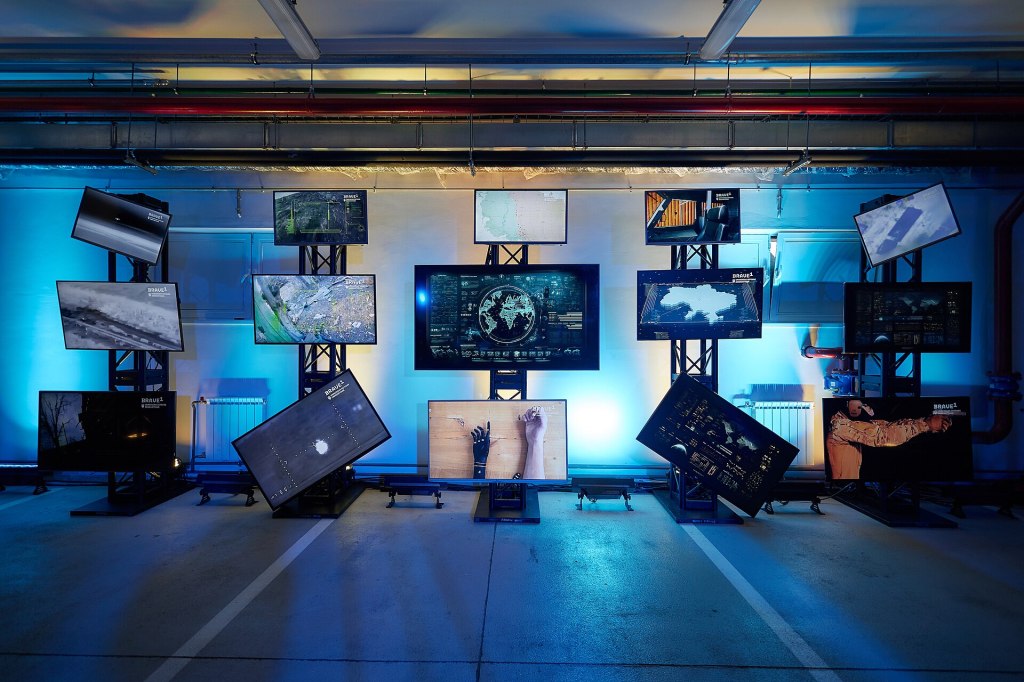
Source: Source: Wikimedia Commons, 26 April 2023 – Presentation of the Ukrainian defense tech cluster Brave1
By Ty Watson
Partnerships with Ukrainian firms are no substitute for a marketplace
Ukraine’s Brave1 Market, launched in April 2025 and billed as an “Amazon for the military”, allows army units order drones and other kit directly from manufacturers. Firms, in turn, can track how their products perform in battle. There is a macabre twist. Since August 2025, units have been able to pay with “ePoints” earned for verified combat missions, including killing Russians. Units upload footage to Delta, the army’s battlefield-management system. Once verified, the government credits ePoints to their accounts for spending on the marketplace.
Ethical quandaries of gamifying war aside, the market works. In its first year, army units ordered $1bn-worth of kit with ePoints and received some 500,000 drones, ground vehicles and electronic-warfare systems. In-stock items arrive in seven days on average. Meanwhile, in Germany, Rheinmetall’s contract for FV-014 loitering munitions, often referred to as “kamikaze drones”, is expected to take about a year from signing to first delivery. Europe may not be fighting for its survival, but it cannot afford to dawdle.
Rather than replicating Brave1, though, Europe is trying cash in on Ukraine’s industry through partnerships. The EU-Ukraine Drone Alliance, an industry group meant to speed up drone production, held its inaugural board meeting on September 11th. In the meeting, Andrius Kubilius, the European commissioner for defence and space, noted that Europe’s airspace was being “tested with repeated drone violations” and that it needed “design cycles in weeks, not months”. It is ironic, then, that a disruptive-technology call from the European Defence Fund expects projects aiming for a “rapid time-to-market” to last one to two years.
Partnerships may not cure Europe’s sluggishness, but they can reward firms that move fast and listen to soldiers. Consider Quantum Frontline Industries (QFI), a venture set up in December 2025 in which Germany’s Quantum Systems builds drones designed by Ukraine’s Frontline Robotics, formed under the Build with Ukraine initiative. QFI won a follow-on contract from Ukraine’s National Guard on October 5th and is preparing to increase its production capacity fivefold for 2027.
Quantum was already valued at more than €1bn by May 2025, so its success predates the partnership. In July, touting its “proven operational deployment at scale” (it says its drones flew more than 19,000 missions in Ukraine last year), it raised €1bn at a valuation of about €7bn. Three things set it apart. It folds soldiers’ feedback into its designs. Its Vector reconnaissance drone ranked third in its class among systems chosen by Ukrainian units on Brave1 last year. And it is quick: QFI’s first drone came off the production line two months after the venture was announced.
Whether such speed lasts is another matter. Jonas Jarosch, Quantum’s finance chief, said in July that the market was “quite heated” and predicted consolidation, with some startups bought and others failing. Germany has shown a willingness to buy from newcomers: Helsing and Stark won loitering-munition deals before Rheinmetall did. But multi-year framework contracts worth billions tend to entrench whoever wins them. The risk is that today’s nimble startups become tomorrow’s lumbering primes.
A market approach guards against that. It enables firms to succeed on product performance rather than because they are entrenched in the military-industrial complex. It is also feasible. In early July the Dutch defence ministry signed a three-year deal worth more than €30m with Intelic, a Dutch startup that runs Base, an online catalogue where European defence ministries can compare and buy drones from manufacturers across the continent. But Base is a private venture, not an official marketplace, and unlike Brave1, it does not let units shop for themselves. Intelic has built a shop window. Europe has yet to let soldiers do the shopping.
Written by Ty Watson
Edited by Iris Pichon and Anh Huynh


Leave a Reply